

close
Choose Your Site
Global
Social Media


Views: 0 Author: Site Editor Publish Time: 2026-10-12 Origin: Site


Commercial garment manufacturing requires balancing fluid drape, high stretch recovery, and production efficiency without sacrificing wearer comfort. Sourcing printed synthetics that maintain vibrant floral patterns under tension often presents a major hurdle on the cutting room floor. Standard polyester knits trap heat, compromising the wearer's experience and leading to poor retail performance. You need materials that solve these exact issues during assembly and in the final garment. Interlock Twist Yarn (ITY) offers a specialized knit structure designed specifically for modern apparel production. A rigorous evaluation of technical specifications, supplier reliability, and cutting-room realities dictates your production success. This guide breaks down how to integrate these textiles into your manufacturing workflow, ensuring high yield and consistent quality across your product lines.
Technical Viability: ITY’s unique twisted yarn construction provides natural mechanical breathability and wrinkle resistance, making it optimal for travel-wear and summer collections.
Performance Metrics: Standard compositions (typically 80-95% polyester and 5-20% spandex) offer superior 4-way stretch, high colorfastness for floral prints, and consistent drape.
Sourcing Strategy: Purchasing bulk breathable ITY flower stretch fabric requires strict GSM (Grams per Square Meter) verification, opacity testing, and stretch-recovery testing to prevent yield loss.
Manufacturing Realities: Proper handling requires specific cutting techniques and sewing machine configurations (e.g., ballpoint needles, walking feet) to mitigate edge curling and seam puckering.
Interlock Twist Yarn relies on a highly specific spinning and knitting process. Manufacturers take continuous synthetic filaments and apply a high twist per inch (TPI) before feeding the yarn into the circular knitting machines. This aggressive pre-twisting step fundamentally alters the physical properties of the polyester fibers. It changes the yarn profile from a flat, smooth filament into a textured, springy structure. This creates a softer, more tactile hand-feel than standard flat jersey knits. The resulting textile drapes heavily and fluidly, pulling away from the body rather than clinging to it. This structural engineering transforms basic synthetic inputs into a premium-feeling material suitable for high-end fashion lines and demanding consumer applications.
Standard flat-filament polyester often traps body heat because the fibers sit flush against one another, blocking airflow. The ITY process solves this through mechanical engineering rather than chemical finishes. The high twist in the yarn creates microscopic gaps within the interlock knit structure. These micro-gaps allow air to circulate freely through the garment. They also facilitate rapid moisture wicking by creating channels for capillary action, pulling sweat away from the skin to the fabric's surface where it evaporates. You get the extreme durability of polyester alongside the cooling properties typically associated with natural fibers. This specific construction makes Breathable ITY Flower Stretch Fabric highly effective for warm-weather collections and active lifestyle garments.
Most ITY textiles utilize a precise blend of polyester and elastane (spandex). The industry standard ratios sit around 80/20 or 95/5, depending on the required application. The polyester provides structural stability, abrasion resistance, and dye affinity. The spandex dictates the fabric's modulus. Modulus refers to the material's resistance to stretch and the force required to elongate it. A higher spandex content increases the modulus and dramatically improves the recovery rate. High recovery ensures garments snap back to their original shape immediately after wear. This dynamic prevents bagging at the knees, elbows, or seat in fitted apparel, maintaining the garment's intended silhouette over its entire lifecycle.
Floral designs require sharp lines, distinct borders, and vibrant color saturation. The smooth face of the interlock knit is highly receptive to dye-sublimation printing. Dye-sublimation uses high heat (typically around 400°F) and pressure to transfer dye directly from printed paper into the synthetic fibers. The colors become a permanent part of the material rather than sitting on top as a surface layer. Complex, multi-color floral patterns remain crisp and do not crack or peel over time. Furthermore, the dense interlock knit prevents "grinning." Grinning occurs when stretched fabric reveals the unprinted white base threads underneath the design. ITY maintains deep color saturation even under maximum tension across the bias.
You must align fabric properties with specific apparel categories to avoid production failures. ITY excels in garments requiring a fluid drape and multi-directional stretch. Wrap dresses benefit from the heavy, swinging drape that pulls the fabric downward, creating a flattering fit. Flowy tops utilize the soft hand-feel and cooling properties for summer wear. Travel-wear lines capitalize on the inherent wrinkle resistance, allowing garments to be packed tightly without creasing. Lightweight leggings rely on the high stretch recovery and opacity to provide coverage and support. Matching the textile's physical properties to the correct silhouette minimizes pattern grading headaches and maximizes consumer satisfaction.
You must analyze the Grams per Square Meter (GSM) before purchasing stretch fabric for apparel production. The ideal GSM range for ITY falls between 150 and 220. Lighter weights around 150 to 170 GSM suit summer tops, loose tunics, and layered garments. Heavier weights approaching 200 to 220 GSM are necessary for opaque maxi dresses, fitted skirts, and unlined trousers. Selecting the wrong GSM leads to structural failure, poor drape, or transparency issues under harsh lighting. Always request physical headers to verify the weight matches your garment specifications before committing to bulk yardage.
GSM Range | Fabric Characteristics | Ideal Garment Applications | Needle Recommendation |
|---|---|---|---|
150 - 170 GSM | Lightweight, high drape, semi-sheer under tension | Blouses, tunics, layered summer dresses | 70/10 Ballpoint |
175 - 195 GSM | Mid-weight, balanced opacity, versatile stretch | Wrap dresses, wide-leg pants, travel wear | 75/11 Ballpoint |
200 - 220 GSM | Heavyweight, full opacity, strong recovery | Fitted skirts, leggings, unlined maxi dresses | 80/12 Stretch |
Opacity is non-negotiable for commercial apparel, especially in fitted categories. You must establish rigorous stretch-test protocols in your quality control lab. Pull the fabric to its maximum horizontal and vertical limits over a contrasting form. Inspect the printed surface under D65 daylight bulbs. Ensure the underlying base threads do not distort the dark or indigo floral backgrounds. If the white base shows through, the print quality is compromised, and the garment will look cheap when worn. Reject batches that fail this visual grin-through test to protect your brand reputation and reduce retail return rates.
Consumers expect garments to retain their shape after multiple wears and washes. You must benchmark the stretch recovery over time using standardized bench tests. Cut a precise 10-inch square of the material. Stretch it to 150% of its original width (15 inches) and hold it under tension for one hour. Release the tension and measure the recovery after exactly ten minutes. High-quality ITY should return to at least 95% of its original dimensions (9.5 inches). Poor recovery leads to sagging necklines, distorted silhouettes, and immediate consumer dissatisfaction.
Modern consumers demand low-maintenance clothing. Document the care properties of your ITY selections for accurate care label generation. The twisted yarn structure inherently resists creasing because the synthetic fibers possess high memory and a stable glass transition temperature. Garments emerge from suitcases ready to wear. They require no ironing and withstand standard machine washing without degrading. Highlight these travel-friendly attributes in your product marketing. They represent significant value additions for the end-user and differentiate your product from high-maintenance natural fibers.
Friction destroys low-quality synthetics, leading to unsightly fuzzing. Assess the durability of the twisted yarn structure against daily abrasion. Conduct standard pill-testing using a Martindale abrasion machine set to 20,000 rubs. The tight twist of ITY fibers naturally resists pilling, usually scoring a grade 4 or 5 on standard testing scales. This guarantees long-lasting, smooth finishes for high-wear garments like trousers and dresses. Durable textiles reduce consumer return rates and build long-term brand loyalty by outlasting cheaper alternatives.
Floral prints often mix dark backgrounds with light, delicate petals. You must prevent dye migration during commercial and consumer washing. Outline necessary laboratory tests using AATCC 61 standards for laundering. Test the fabric in warm water with standard commercial detergents and steel balls to simulate wash friction. Ensure the deep indigo, black, or crimson backgrounds do not bleed into the white or pastel floral elements. Strict colorfastness testing prevents catastrophic inventory losses and ensures the garment looks identical after fifty washes.
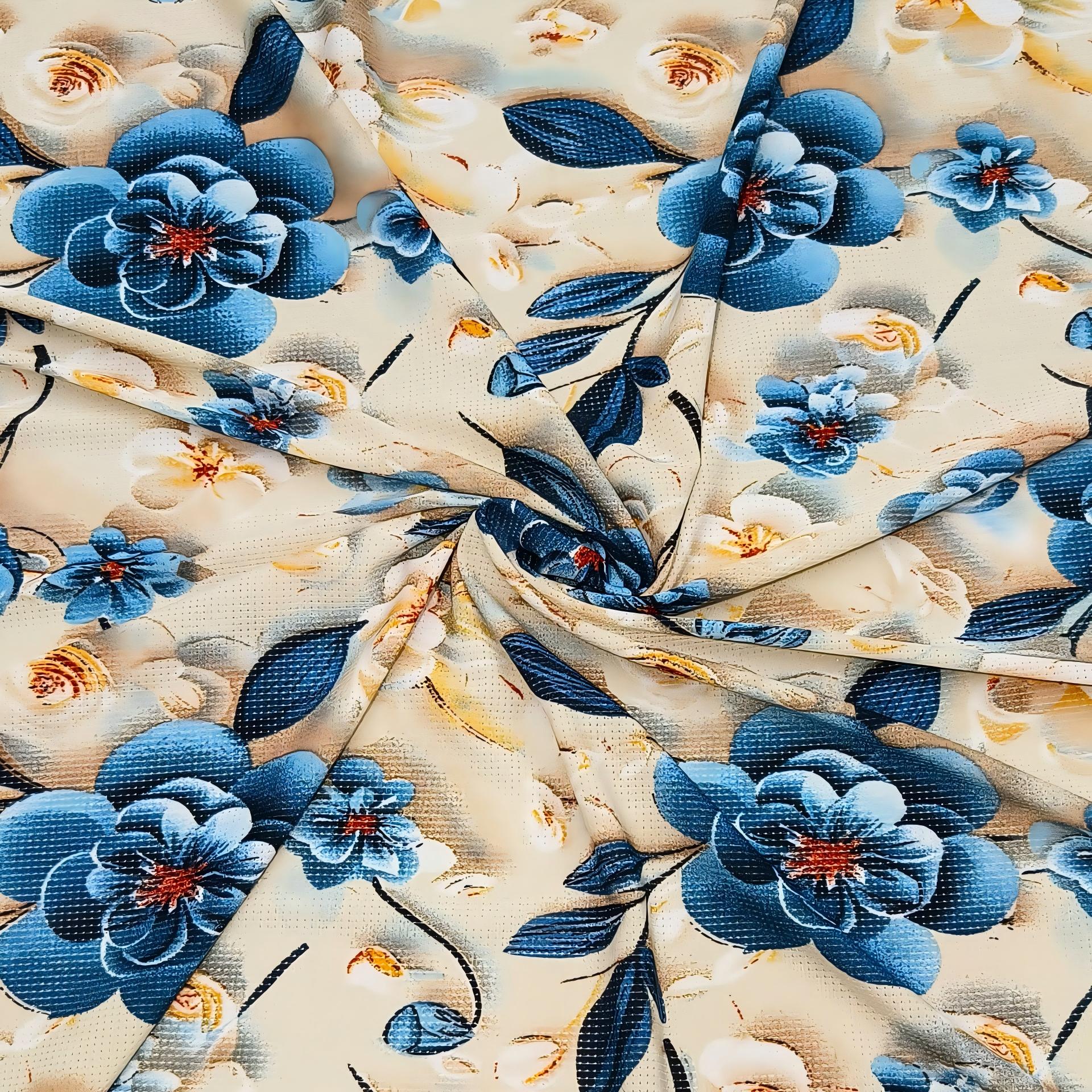
When sourcing wholesale printed fabric for garments, compare ITY directly to standard flat polyester jersey. Standard jersey lacks the pre-twisted yarn. It feels flat, looks shiny, and often traps body heat, leading to a clammy feel. ITY offers superior mechanical cooling through its micro-gaps. It also provides a much heavier, more fluid drape that flatters the body. Furthermore, ITY resists pilling significantly better than basic jersey due to the tight yarn twist. The structural differences and improved consumer experience easily justify the slight premium in raw material cost.
Cotton spandex blends offer natural softness but fail completely in moisture management. Cotton absorbs and retains sweat, holding moisture against the skin. It becomes heavy, loses its shape, and feels uncomfortable in hot weather. ITY wicks moisture away and dries rapidly. Additionally, cotton prints fade quickly under UV exposure and repeated washing due to the nature of reactive dyes. ITY locks in dye-sublimated colors permanently. Choose ITY when vibrant, long-lasting floral prints and shape retention are your primary manufacturing objectives.
Evaluate the structural differences between these two distinct stretch knits. Wholesale printed rib flower fabric features alternating raised and lowered rows. This creates high horizontal stretch and a distinct physical texture. However, the ribbed texture can distort intricate floral prints when stretched, breaking the visual continuity of the pattern. ITY provides a completely smooth face. This smooth canvas is ideal for high-definition, photorealistic floral patterns. ITY also offers balanced multi-directional stretch, unlike the heavy horizontal bias of rib knits, making it better suited for complex draping.
Rayon and viscose offer excellent drape and a soft hand-feel but suffer from poor dimensional stability. They are highly prone to shrinkage, bagging, and distortion when wet. Manufacturers must handle them with extreme care during the cutting and sewing phases. ITY provides a similar fluid drape but remains highly stable. It resists shrinking during both manufacturing steam pressing and consumer washing. Trade the slight natural feel of rayon for the robust, predictable performance and lower defect rates of ITY in bulk production environments.
Sourcing bulk breathable ITY flower stretch fabric requires strict supplier vetting to maintain production schedules. Define your criteria for auditing wholesale partners. Demand consistency in roll-to-roll color matching. A slight shade variation between rolls ruins a production run when panels are mixed. Implement a strict 4-point inspection system upon receiving goods.
Inspect for continuous defects like needle lines or dye streaks.
Count point defects such as holes, slubs, or misprints per 100 linear yards.
Measure the actual usable width against the invoiced width.
Verify the GSM of each roll against the approved master sample.
Reliable suppliers provide inspection reports detailing these metrics before shipping. Reject suppliers who refuse to guarantee their defect tolerances or replace substandard rolls.
Brand alignment often requires custom floral patterns rather than stock prints. Navigate the process of requesting specific background shades carefully. Provide exact Pantone TCX (Textile Cotton System) codes to your supplier for accurate matching. Deep indigo, seasonal pastels, and vibrant neons require entirely different dye formulations and sublimation times. Request physical lab dips before authorizing bulk production. Review these dips inside a calibrated light box under multiple light sources (D65 daylight, fluorescent, incandescent) to ensure the colors remain true to your design intent and do not suffer from metamerism.
Accurate yield calculation prevents fabric waste and protects your profit margins. Standard usable widths for ITY typically run between 58 and 60 inches. However, the nature of the knit causes selvedge curling, which reduces the actual cuttable width. Measure the flat, uncurled center of the roll. Base your marker making solely on this usable dimension. Failing to account for edge curling results in cut pieces that are too narrow, causing costly recuts, wasted yardage, and bottlenecked sewing lines.
Analyze how custom print runs affect your MOQs. Sourcing stock floral prints usually allows for lower minimums, often around 500 yards. Custom dye-sublimation runs require larger commitments to offset digital setup costs or screen engraving. Negotiate tiered pricing structures with your supplier. Plan your seasonal scalability. Secure favorable rates for initial prototype yardage while locking in lower per-yard costs for the final bulk production orders. Clear communication regarding annual volume expectations often yields better pricing on custom prints.
Consumer safety is paramount in modern apparel manufacturing. Detail the importance of chemical compliance to your sourcing team. Ensure the dyes used in the floral prints are free from restricted substances. Demand OEKO-TEX Standard 100 certification or REACH compliance documentation for every batch. These certifications guarantee the textiles contain no harmful heavy metals, formaldehyde, or toxic azo dyes. Compliant materials protect your customers from skin irritation and shield your brand from costly recalls and legal liabilities.
ITY fabric is inherently slippery, heavy, and stretchy. Address the risk of fabric distortion during the spreading phase. Never pull the fabric tightly across the cutting table, as this builds latent tension into the stack. Recommend tension-free spreading techniques using automated machines with positive feed rollers. Allow the spread layers to relax on the table for at least 12 to 24 hours before cutting. This relaxation time lets the twisted yarns return to their natural state. Cutting immediately after spreading guarantees misshapen garment panels once the fabric shrinks back to its resting dimensions.
Discuss the tendency of ITY to shift under the blade. Mitigate this by using specific cutting room strategies. Place layers of dotted marking paper or tissue paper between the fabric plies to increase friction and stabilize the stack. Ensure your rotary blades or straight vertical knives are exceptionally sharp to prevent snagging the spandex fibers. For large-scale operations, utilize automated CNC vacuum cutting tables. The vacuum compresses the layers tightly, eliminating shifting, preventing ply slippage, and ensuring millimeter-perfect cuts across the entire marker.
Provide technical specifications for the assembly line to prevent seam failure. Standard sharp needles will cut the spandex fibers, causing holes and skipped stitches that expand over time. Mandate the use of ballpoint or stretch needles (sizes 70/10 or 75/11). These needles slide between the knit loops without damaging the yarn. Use high-quality textured polyester thread for its inherent elasticity. Configure serger and overlock machines with a differential feed ratio between 1.5 and 2.0 to prevent the seams from stretching, waving, and puckering during sewing. Maintain a stitch density of 10 to 12 stitches per inch (SPI) for optimal seam elongation.
Synthetic fibers react poorly to high heat. Warn your finishing department against aggressive pressing techniques. High-heat irons will glaze the surface of the ITY, leaving permanent shiny marks that ruin the garment. Extreme heat can even melt the microscopic spandex fibers, destroying the stretch recovery entirely. Outline safe pressing temperatures, keeping irons below 300°F. Always use protective press cloths or Teflon iron shoes. Utilize steam rather than direct dry heat to relax seams safely and remove minor wrinkles without damaging the fabric structure.
Order 5-yard sample cuts of ITY fabric to run physical wash, stretch, and recovery tests in your facility before approving bulk orders.
Calibrate your cutting room vacuum tables and install fresh 75/11 ballpoint needles on all overlock machines to prevent fabric damage.
Request complete OEKO-TEX compliance certificates and lab dip approvals from your supplier prior to signing purchase agreements.
Update your marker making software to account for a 58-inch cuttable width, leaving a safe margin for selvedge curling.
A: ITY stands for Interlock Twist Yarn. It refers to a specific knitting process where synthetic yarns are tightly twisted before being knit. This twist creates a softer texture, better drape, and increased mechanical breathability compared to standard flat knits.
A: Yes. The pre-twisted yarns create microscopic gaps in the knit structure. These gaps allow air to circulate and moisture to wick away from the body. This mechanical breathability makes it highly suitable for warm-weather apparel despite being a synthetic blend.
A: The standard weight typically ranges from 150 to 220 GSM. Lighter weights (150-170 GSM) are ideal for flowing tops and tunics. Heavier weights (180-220 GSM) provide the necessary opacity and structure for maxi dresses and skirts.
A: ITY offers a completely smooth surface with balanced 4-way stretch, making it perfect for high-definition floral prints. Rib knits have a textured, raised surface and primarily offer high horizontal stretch, which can distort printed patterns when pulled.
A: No. ITY is typically printed using a dye-sublimation process. The heat transfers the dye directly into the polyester fibers, permanently locking in the color. It exhibits excellent colorfastness and resists fading even after repeated commercial washing.
A: You must use ballpoint or stretch needles, typically in sizes 70/10 or 75/11. These needles are designed to slide between the knit loops rather than piercing them, which prevents skipped stitches and permanent damage to the spandex fibers.
