

close
Choose Your Site
Global
Social Media


Views: 0 Author: Site Editor Publish Time: 2026-10-05 Origin: Site


The apparel industry's shift toward comfort-centric, travel-friendly garments is forcing sourcing directors to re-evaluate traditional woven textiles. Upcoming 2027 collections demand high-performance knits that move with the wearer. Balancing vibrant print retention, structural drape, and wearer comfort in bulk manufacturing presents a significant operational challenge. Sourcing teams frequently struggle to find textiles offering multi-directional stretch without causing floral pattern distortion or compromising thermal regulation on the factory floor.
This guide breaks down the technical specifications, market trajectory, and comparative procurement frameworks for breathable ITY flower stretch fabric. We detail material mechanics, printing advancements, and supply chain strategies. You will learn how to evaluate yarn twist levels, mitigate pattern warping during cutting, and bypass middlemen using advanced digital discovery techniques. This equips buyers to make resilient, quality-driven supply chain decisions for upcoming production cycles.
Performance Baseline: True breathable ITY (Interlock Twist Yarn) relies on a specific twist mechanism in its polyester spandex stretch fabric blend to create micro-gaps, enhancing airflow compared to traditional flat knits.
Comparative Advantage: In the evaluation of CEY floral woven fabric vs ITY stretch fabric, ITY consistently yields lower defect rates in high-movement garments due to its superior elastic recovery and wrinkle resistance.
Sourcing Risk: The primary implementation risk for 2027 is pattern distortion during the sublimation printing process; mitigating this requires strict tension-control testing at the mill level.
Market Trajectory: Demand for printed fabric for floral apparel using ITY constructions is projected to scale rapidly as direct-to-consumer brands prioritize "wash-and-wear" product lines.
Advanced Procurement: Leveraging advanced digital search techniques and vendor cheat sheets allows sourcing teams to bypass middlemen and uncover direct-to-mill partnerships globally.
Modern floral apparel requires a strict baseline of technical requirements. Garments must sit at the exact intersection of elasticity, thermal regulation, and print clarity. Consumers reject dresses and tops that trap heat or restrict movement. Simultaneously, intricate floral motifs demand a stable canvas. If a knit stretches out of shape during wear or laundering, the printed design warps, instantly degrading the garment's visual value. Establishing a reliable standard means sourcing textiles that recover their original dimensions immediately after tension is released, all while maintaining a cool touch against the skin. Factory managers require fabrics that behave predictably during spreading and cutting to maintain high yield efficiencies.
Achieving optimal performance starts at the fiber level. The industry standard for high-quality polyester spandex stretch fabric relies on precise blend ratios. Most successful ITY constructions utilize 90% to 95% polyester paired with 5% to 10% spandex (elastane). This specific ratio provides robust four-way stretch without inducing fiber fatigue over repeated wear cycles. The polyester component provides the necessary strength and dye affinity for vibrant floral prints, while the elastane core delivers the recovery.
Yarn specifications heavily influence the final product. Sourcing teams must evaluate denier count, twist levels, and elastane integration methods to ensure the fabric meets the specific needs of the garment design.
Denier Count | Fabric Weight (GSM) | Primary Garment Application | Opacity Level |
|---|---|---|---|
50D / 72F | 140 - 160 GSM | Layered tops, sheer overlays, lightweight linings | Semi-sheer (requires lining for bottoms) |
75D / 72F | 180 - 200 GSM | Standard wrap dresses, blouses, flowing skirts | Opaque (standard industry baseline) |
100D / 144F | 220 - 250 GSM | Unlined maxi dresses, structured knit trousers | Fully opaque (squat-proof) |
Bare spandex core yarns wrapped in polyester filaments ensure the elastic component remains protected from direct heat during printing and finishing. Premium elastane prevents the bagging effect at high-stress points like knees and elbows. Sourcing directors must specify core-spun yarns to prevent the elastane from degrading under the high heat of sublimation presses.
The defining characteristic of ITY is its manufacturing process. Mills insert a high degree of twist into the synthetic yarn before knitting. This twist alters the physical structure of the fiber, creating a textured, slightly crepe-like hand feel. Unlike flat jersey knits where yarns lay parallel and dense, the twisted yarns push against each other. Manufacturers typically alternate S-twist and Z-twist yarns during the knitting process to balance the torque, preventing the fabric from skewing or twisting diagonally after washing.
This structural tension inherently creates micro-gaps within the knit matrix. These gaps function as moisture-wicking channels. As the wearer generates body heat and perspiration, the porous structure allows air to circulate and moisture to evaporate rapidly. When evaluating thermal regulation, ITY consistently outperforms standard flat-knit synthetics. The twist also reduces the surface area of the fabric resting directly against the skin, contributing to a cooler, drier sensation during extended wear. This mechanical breathability is permanent and does not wash out like chemical wicking finishes.
Consumer preferences heavily dictate textile sourcing. The current market demands low-maintenance apparel. Shoppers actively seek out wash-and-wear garments that require zero ironing. ITY perfectly aligns with this demand due to its inherent wrinkle resistance. The high-twist yarn acts like a microscopic spring. When crushed in a suitcase or worn during a long flight, the fibers bounce back to their original state upon unpacking.
This mechanical resilience translates directly to commercial success for resort wear, travel capsules, and everyday dresses. Brands marketing fluid, packable floral dresses rely on ITY to deliver on these performance promises. The fabric's ability to maintain a pristine appearance without steaming reduces returns and drives positive customer reviews. Retailers are expanding their knit dress categories specifically to capitalize on this consumer behavior, shifting open-to-buy dollars away from high-maintenance wovens.
Floral designs require precise color separation and sharp edge definition. The 2027 printing landscape relies heavily on advanced sublimation and reactive digital printing technologies. These methods optimize dye penetration on high-twist synthetic yarns. Older printing techniques often failed to coat the entire twisted fiber, leading to surface-level coloration that faded quickly.
A historical challenge in sourcing printed fabric for floral apparel is grin-through. This occurs when a dark-ground floral print is stretched, revealing the unprinted white base knit underneath. Modern mills combat this by utilizing deep-penetration sublimation inks and adjusting the heat-press dwell times. Disperse dyes require temperatures around 200°C to sublimate effectively into the polyester fibers. Additionally, knitting the base fabric with a higher gauge minimizes the expansion gaps that cause grin-through. Sourcing directors must verify a mill's printing technology to ensure dark floral patterns remain opaque under maximum stretch.
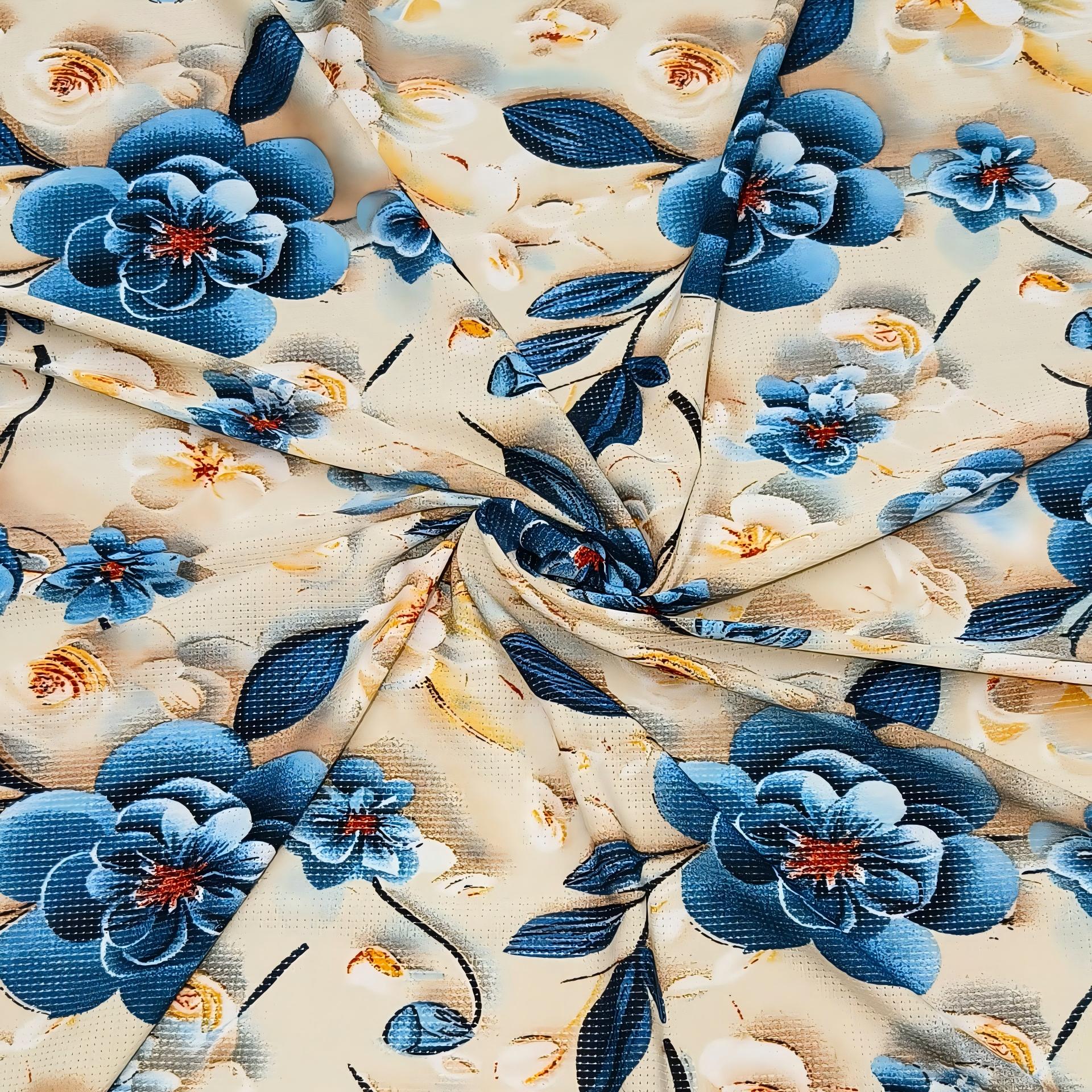
Sourcing directors frequently face a critical choice when developing floral lines: select a woven or a knit. Establishing a direct comparative framework clarifies this decision. Both textiles offer distinct advantages depending on the garment's intended silhouette and end-use. Understanding the mechanical differences prevents costly misalignments between fabric capabilities and design intent on the factory floor.
When analyzing CEY floral woven fabric vs ITY stretch fabric, drape and structure form the primary dividing line. CEY (Composite Elastic Yarn) wovens provide structured volume. They possess a distinct crepe effect and mechanical stretch achieved through weaving techniques rather than elastane insertion. CEY holds shapes well, making it ideal for tailored silhouettes, puff sleeves, and structured blouses where the fabric needs to stand away from the body.
Conversely, ITY knits deliver fluid drape and body-contouring elasticity. The fabric falls heavily, skimming the body rather than standing away from it. This fluidity makes ITY superior for wrap dresses, maxi skirts, and active-leisure crossover pieces where movement and flow are paramount. The weight of the ITY pulls the garment downward, creating a slimming silhouette that consumers favor in floral prints.
Air permeability rates differ significantly between the two constructions. CEY features a tightly woven grid. While lightweight, this grid restricts airflow more than a knit structure, especially when wet. ITY, with its micro-porous twisted yarn construction, allows higher volumes of air to pass through the textile. For summer apparel or garments intended for humid climates, ITY offers superior moisture management and thermal regulation, preventing the clammy feeling associated with flat woven synthetics.
Overall value depends on mill-level production costs, standard minimum order quantities, and yield efficiencies during the cutting and sewing phases. Wovens generally offer higher cutting yields because they lay flat and stable on the cutting table. Knits require specialized handling to prevent stretching during spreading, which can slightly reduce overall yield efficiency if the factory lacks automated tensionless spreaders.
Evaluation Metric | CEY Floral Woven Fabric | ITY Stretch Fabric |
|---|---|---|
Stretch Capability | Mechanical stretch (limited, usually 2-way) | Spandex-driven stretch (robust 4-way) |
Drape & Volume | Structured, holds volume away from body | Fluid, heavy drape, body-contouring |
Cutting Efficiency | High (stable edges, minimal curling) | Moderate (requires tensionless spreading) |
Wrinkle Resistance | Moderate to High | Extremely High (Travel-friendly) |
Air Permeability | Lower (tight woven grid) | Higher (micro-porous knit structure) |
Seam Slippage Risk | Higher (requires wider seam allowances) | Lower (knit structure absorbs seam stress) |
Bulk garment assembly introduces significant implementation realities. The primary risk with high-stretch knits is floral motifs warping across the bias during cutting and sewing. If fabric is pulled too tightly during the spreading phase, it will snap back after cutting. This results in misshapen garment panels, distorted prints, and mismatched seams that fail quality control inspections.
Mitigation requires strict protocols written directly into vendor contracts. Sourcing teams must specify the use of tensionless spreading machines. Furthermore, fabric rolls must rest horizontally on the cutting table for 24 to 48 hours before cutting. This relaxation period allows the elastane to recover from the tension of being tightly wound on a roll. Mandating pre-shrinking and tensionless curing protocols during the fabric finishing stage ensures the textile reaches the cutting floor in a relaxed state. Auditing the factory's handling procedures prevents costly entire-batch rejections.
Forecasting raw material availability remains crucial. Specialized polyester and elastane blends face periodic petrochemical supply chain disruptions. Relying on a single geographic region for knitting and printing creates unacceptable seasonal bottlenecks, especially leading up to major retail delivery windows.
Diversifying mill partnerships across emerging textile hubs mitigates this risk. Establishing secondary suppliers in regions like Vietnam, India, or Turkey provides leverage and backup capacity. Sourcing directors must secure capacity blocks well in advance of peak production seasons, locking in raw material prices to stabilize the overall cost of goods sold. Maintaining a dual-sourcing strategy for core floral prints ensures continuous supply even if one region faces logistical delays.
Environmental compliance is no longer optional. The rise of recycled polyester (rPET) derived from post-consumer plastic bottles is transforming ITY manufacturing. Sourcing teams must evaluate mills based on their ability to blend rPET without compromising the yarn's twist integrity or stretch recovery. Poor quality rPET can lead to brittle yarns that snap during the high-twist knitting process.
Navigating global chemical compliance is equally critical. Dyes used in floral printing must meet strict safety standards. Mandating OEKO-TEX Standard 100 Class II certification ensures the fabric is free from harmful substances and safe for direct skin contact. Buyers should request valid, up-to-date certificates directly from the printing facility, verifying that both the base fabric and the sublimation inks comply with international toxicity regulations. Do not accept certificates from third-party brokers without verifying the mill's registration number on the official OEKO-TEX portal.
Finding capable direct-to-mill partnerships requires moving beyond basic search engine queries. Procurement teams must leverage advanced digital sourcing techniques to bypass trading companies and brokers who add unnecessary margins and obscure the true origin of the fabric.
Leveraging Boolean Search: Use specific operators to filter out retail results. Search strings like "ITY stretch fabric" AND "mill" AND "sublimation" -retail narrow the focus to actual manufacturers.
Utilizing inURL Operators: Target specific pages on supplier websites. A search like inurl:certification "ITY stretch fabric" immediately surfaces vendors who publicly host their compliance documents, indicating transparency.
Global Trade Reference Databases: Utilize specialized commercial reference desks and zero-click search strategies. Verify a supplier's export history, shipping volumes, and manufacturing capabilities through customs data before initiating outreach. Look for consistent shipment weights that indicate actual manufacturing rather than sporadic brokering.
Image Reverse Searching: Use reverse image search on floral pattern swatches to identify if a supplier is the original creator or just a reseller using stolen catalog photos from legitimate mills.
Rapid evaluation minimizes wasted time. Sourcing directors should utilize a strict checklist to assess a vendor's true capabilities. Prioritize mills with in-house knitting and printing. Outsourcing the printing phase to a third-party facility increases handling errors, extends lead times, and complicates quality control accountability. Verify the gauge of their circular knitting machines and the age of their digital sublimation printers. Newer equipment yields tighter knits and sharper floral resolutions.
Vetting Category | Mandatory Requirement | Red Flag Indicator |
|---|---|---|
Production Integration | In-house knitting and digital printing | Refusal to provide factory floor video tour |
Equipment Age | Sublimation printers under 5 years old | Visible banding or ghosting on print samples |
Compliance | Direct OEKO-TEX certificate in mill's name | Certificate registered to a trading company |
Yarn Sourcing | Traceable rPET supply chain documentation | Inability to name the yarn extrusion partner |
Never proceed to bulk production without independent laboratory testing. Mandate the following protocols on pre-production samples to ensure the fabric performs under consumer conditions:
Colorfastness to Washing and Rubbing: Utilize ISO 105-C06 for wash fastness and ISO 105-X12 for crocking to ensure dark floral dyes do not bleed onto lighter areas or other garments during consumer laundering.
Pilling Resistance (Martindale Method): Execute ASTM D4970. Ensure the high-twist yarns withstand abrasion without forming surface pills. ITY should naturally resist pilling, making this a great test of yarn quality.
Elongation and Recovery: Utilize ASTM D2594 testing standards to measure how far the fabric stretches and, more importantly, what percentage of its original shape it recovers within one minute. Target a minimum 95% recovery rate.
Dimensional Stability: Measure shrinkage after three wash-and-dry cycles using AATCC 135 to guarantee garment fit consistency. Shrinkage must remain under 5% in both length and width.
Breathable ITY flower stretch fabric remains the most commercially viable textile for scalable, comfort-driven floral apparel in 2027. Its success relies entirely on buyers strictly controlling print tension, yarn twist specifications, and elastane quality. Sourcing teams must prioritize mills offering integrated digital printing and knitting, verifiable stretch-recovery data, and transparent rPET blending options. Utilize advanced search operators to verify these claims before engagement.
To execute a flawless sourcing strategy, take these immediate next steps:
Request 5-yard sample headers of both ITY and CEY fabrics to conduct side-by-side drape and cutting evaluations on your factory floor.
Initiate rigorous wash-and-wear testing on prototype garments to monitor fiber fatigue, seam slippage, and print grin-through.
Audit all shortlisted vendors for current OEKO-TEX Class II compliance and request their documented tensionless spreading procedures.
Draft vendor contracts that explicitly define acceptable shrinkage tolerances, colorfastness ratings, and penalties for pattern distortion.
A: ITY utilizes a high-twist yarn manufacturing process. This twist alters the physical structure, creating micro-spaces within the knit matrix. These gaps allow for significantly better air circulation and rapid moisture evaporation compared to flat, tightly knit synthetic jerseys, keeping the wearer cooler.
A: CEY offers a lightweight, structured woven feel with limited mechanical stretch, ideal for voluminous silhouettes. ITY provides a heavier, fluid drape with superior multi-directional spandex stretch. ITY's porous knit structure and fluid movement make it better suited for form-fitting, breathable summer wear.
A: The optimal balance is typically a 90% to 95% polyester and 5% to 10% spandex ratio. This specific blend provides the necessary print clarity and durability from the polyester, alongside robust elastic recovery and comfort from the spandex.
A: High-quality ITY knit with premium spandex retains its shape exceptionally well due to high elastic recovery. However, low-grade alternatives may suffer from fiber fatigue and bagging, especially if subjected to high heat drying or if the elastane core is damaged during printing.
A: Specify deep-penetration sublimation printing or reactive digital printing. Ensure the base fabric is knit with an appropriately high gauge. Tighter loops prevent the white base fibers from exposing themselves when the dark printed surface is stretched.
A: No. The high-twist nature of Interlock Twist Yarn makes it highly resistant to pilling. The fibers are tightly bound together, preventing the loose ends that typically tangle and form pills on brushed or low-twist synthetic knits.
A: Procurement teams should use Boolean search strings and specific operators like inurl:certification to filter out trading companies. This strategy bypasses middlemen, helping buyers find direct manufacturers with verifiable sustainability certifications and in-house production capabilities.
